When a product launch brief lands on your desk and the budget is approved, the first strategic question is often this: do you take the brand to the street in something iconic, or anchor it in a fixed, high-footfall space? Deciding between a kombi van vs fixed venue for brand activations in Singapore is rarely straightforward, both formats can deliver strong results, and both can fall flat when mismatched to the wrong campaign objectives. At Scoopy’s & Cream (Supericecreamtruck.com Department) we’ve deployed kombi van activations and fixed-venue pop-ups across Singapore for over 17 years, and in our experience, the format decision is almost always what separates a memorable activation from a forgettable one.
This guide gives you the real costs, the permit checkpoints, and a clear decision framework so you can walk into your next vendor briefing knowing exactly what to ask for.
What each format actually delivers on the ground
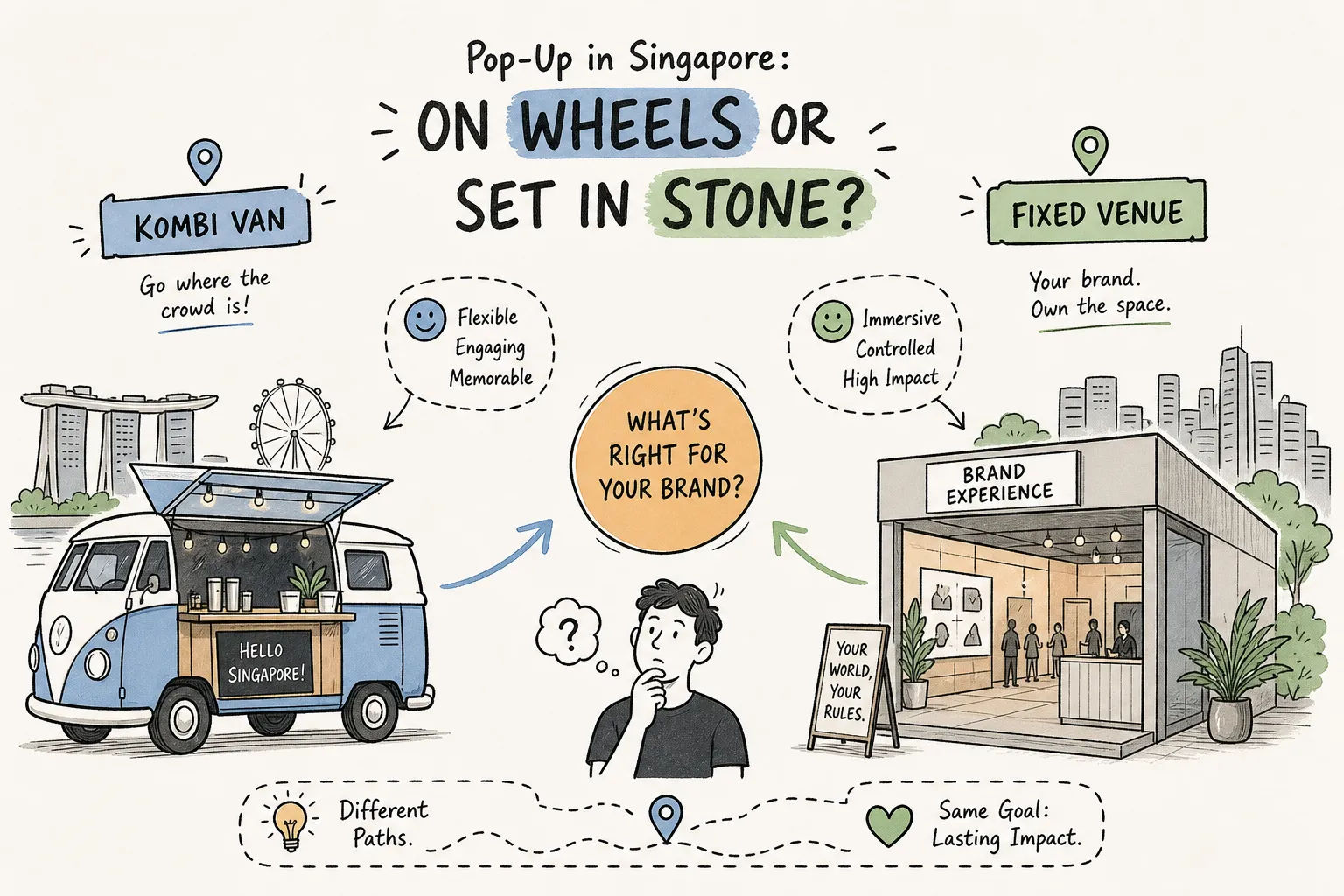
A branded kombi van activation is, at its core, a fully wrapped, deployable vehicle that functions as a mobile sampling station, mini-showroom, or pop-up booth. The key differentiator is straightforward: it goes where the audience is. A CBD lunch crowd on Monday, a residential estate on Tuesday, a tech campus on Wednesday. The visual novelty of an iconic vehicle is a built-in attention mechanism that a standard kiosk rarely matches, and that stopping power tends to generate organic social sharing before a single piece of paid media runs. Not only that, you don’t have to be defined in a fixed location, you can opt for a few locations, and move around in the same kombi van that is already wrapped in your branding. This method reduces rebuild costs significantly and saves you the trouble of applying for a new permit to works for each new location.
A fixed-venue activation delivers something different: a consistent location, greater square meterage, a controlled brand environment, and the ability to support longer, richer experiences such as product demos, consultations, and workshops. Published results support this, well-executed fixed pop-ups in Singapore have recorded dwell times of 396 hours across a campaign period (Lazada’s Orchard Road festive pop-up) and participant counts above 6,000 (the Heineken Maltiverse Experience). Fixed venues allow deeper brand storytelling because audiences aren’t moving through; they’re staying.
The core trade-off comes down to reach versus depth. Kombi van activations maximise reach at the expense of depth; fixed venues maximise depth at the expense of reach. Neither format is categorically superior, and the right answer depends entirely on what your campaign is actually trying to achieve.
Kombi van vs fixed venue for brand activations in Singapore, comparing the real costs
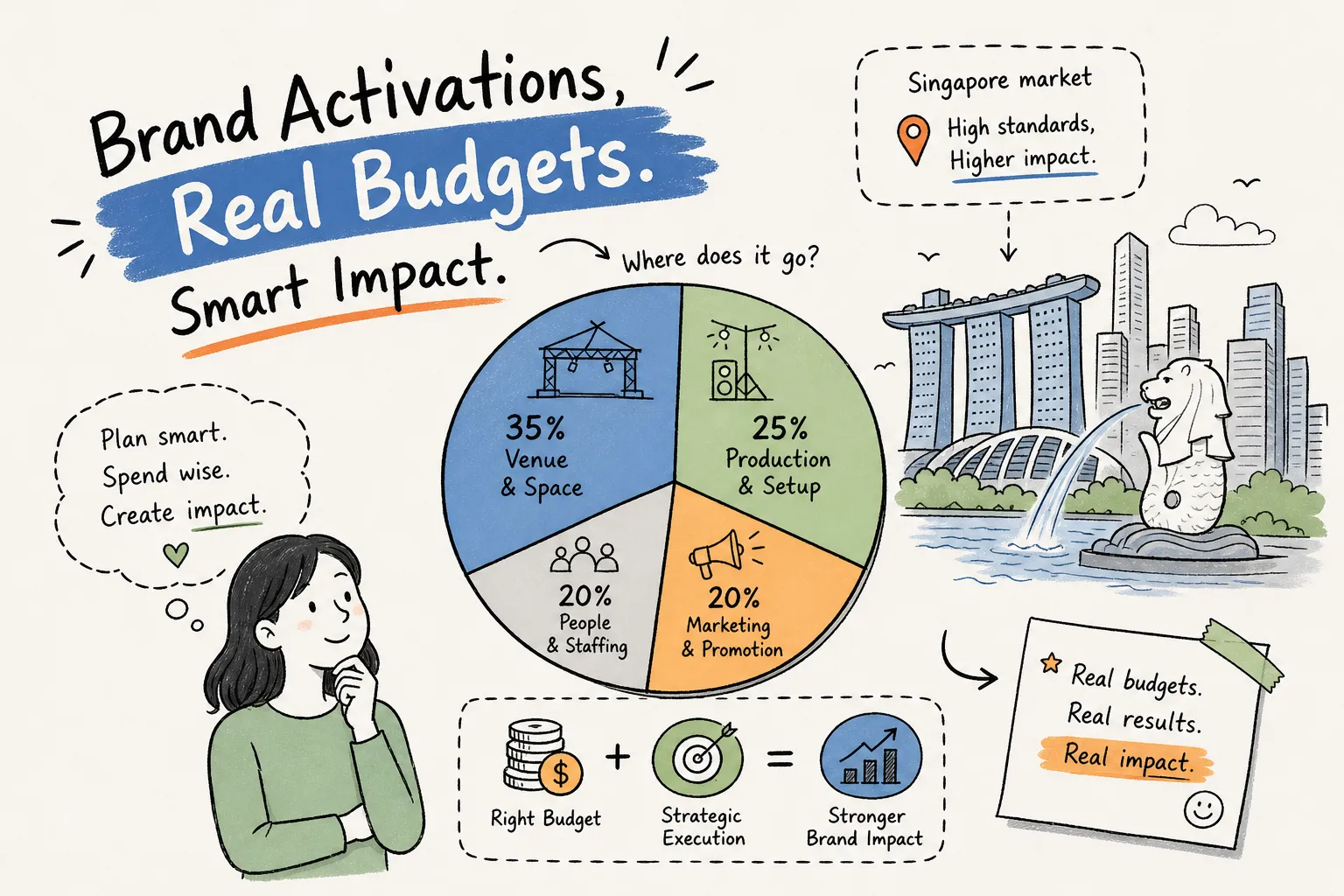
For a kombi van activation, daily cost for a straightforward one-day roadshow or pop-up runs from SGD 2,500 onwards depending on vehicle type, crew size, and fit-out requirements. Longer terms from three days onwards would usually get you better stacked discounted rates, even more so for weekly or monthly bookings, where you would get quite a few days free within the package. A van driver to help drive and rove typically runs from SGD 250 onwards for a few hours, with vintage VW kombi-style vehicles sitting at the higher end compared to modern standard panel van or box-van formats. Add one or two event staff at SGD 18 to SGD 20 per hour. For basic branding wrap and fit-out, it usually depends on the design and the existing colour of the chosen vehicle. Overall you would need a realistic working budget. Multi-day campaigns benefit from economies of scale on crew and logistics, so the per-day cost generally drops as the programme extends.
Fixed venue hire covers a much wider range. Small mall kiosks and atrium spaces can start from as little as SGD 150 to SGD 1,000+ per day for basic formats. Mid-market shopfront and pop-up spaces commonly run SGD 1,000 to SGD 8,000+ or more per day, depending on location and size. A central Orchard Road or CBD mall will be at the higher end and will book out months in advance, particularly during Q4 and Chinese New Year. Community-centre-style spaces can come in lower, around SGD 500 to SGD 1,800 per day, but the footfall profile is very different from a prime retail corridor.
Hidden costs are where budgets get caught out on both sides. For fixed venues, mall operators frequently charge administration fees on top of the space hire rate, plus fit-out and removal fees, loading bay charges, power supply setup, and public liability insurance premiums. For kombi activations, unexpected costs typically come from parking, ERP gantry routing, and crew overtime when activations run longer than planned. Neither format is immune to cost creep; the difference is where it shows up.
Daily kombi van activation costs at a glance
- Kombi van rental: SGD 2,000 to SGD 3,000+ per day depending on model and drivability
- Kombi van wrapping and decal: depends on the current colour of the kombi. Could be from SGD 800 for die-cut decals, to SGD 3,000 to SGD 5,000 for a full wrap including roof and internal counters
- Van driver for roving: SGD 300 to SGD 500 per day for up to seven or eight hours (vintage kombi-style at the higher end)
- Event staff (one to two): SGD 18 to SGD 20 per hour, minimum four hours
- All-in estimate: from SGD 2,000 per day
Daily fixed venue hire costs at a glance
- Mall kiosks and atrium spaces: SGD 150 to SGD 1,000+ per day
- Mid-market shopfront or pop-up space: SGD 1,000 to SGD 8,000+ per day
- Community-centre-style spaces: SGD 500 to SGD 1,800 per day
- Additional: admin fees, fit-out, power setup, insurance premiums
Permits for kombi van vs fixed venue brand activations in Singapore
Mobile brand activations, whether a roadshow van or a mobile pop-up, on public land in Singapore require a Temporary Occupation Licence (TOL) from the Singapore Land Authority (SLA), or NParks approval if the location falls within a park. The SLA TOL processing fee is SGD 173.25 (non-refundable), with a variable TOL fee based on area and event type. Standard processing time from a complete submission is approximately one month.
If the activation includes vehicle-mounted signage or outdoor advertising, a BCA signboard licence applies: roughly SGD 20 to SGD 140 per sign depending on size, with a standard processing time of about seven working days. If URA review is triggered, add approximately two more weeks. Food or beverage sampling introduces SFA requirements, with a two-to-four-week application lead time as a standard working assumption.
For fixed venue and mall pop-ups, the primary dependency is written landlord approval from the mall operator. Supporting documents typically include business registration, public liability insurance (CapitaLand’s standard requirement is SGD 2 million per occurrence), an operations plan, and compliance with the venue’s fit-out rules covering power draw, noise, and footprint. SCDF Temporary Change of Use permits are required at least three working days before the event for applicable structures. Food sampling follows the same two-to-four-week SFA timeline as mobile activations.
The planning window most marketers underestimate is eight to twelve weeks minimum for a mid-sized activation with custom production and any food or signage component. Complex or multi-location programmes should budget three to six months. Start venue or land-use approvals first, they sit on the critical path and have no shortcuts. If you only have a short lead time, around a week or so left to the actual event, supericecreamtruck.com are probably the guys to look for.
Brand visibility and organic social reach compared
The visual novelty of a vintage or fully branded vehicle in an unexpected urban location is one of the most reliable organic social triggers in experiential marketing. Bystanders photograph and share the vehicle without any prompting, generating earned impressions at no additional media cost. For brands targeting younger demographics in Singapore who are active on Instagram and TikTok, the vehicle itself functions as a content set, not just a sales point. That earned media value can be difficult to quantify precisely, but it is real and repeatable in the right environments.
Fixed venues present a different case for visibility. The Heineken Maltiverse Experience recorded more than one million impressions alongside 6,000-plus participants, while the Lazada festive pop-up generated 5,600 direct engagements across 396 hours of cumulative dwell time. Fixed venues tend to be the stronger format when lead quality matters more than reach volume. Longer dwell time means more structured brand experiences, better data capture conditions, sign-up mechanics that actually work, and lead-gen screens that audiences have time to engage with.
Based on campaign benchmarks from Singapore brand activation projects, mobile roadshow activations typically run at approximately SGD 10 to SGD 25 cost per lead, compared to SGD 20 to SGD 55 for fixed pop-up experiences. The kombi van is cheaper per lead at scale; the fixed venue produces higher-quality leads in concentration.
Logistics and setup requirements that matter on the ground
Kombi activations require a clear power strategy from the outset. Options include a built-in generator (with ventilation, noise, and fuel considerations), a site hookup if the location permits it, or battery-based systems for shorter activations. Generators must be positioned in properly ventilated areas and cannot operate in enclosed spaces; build the fuel runtime strategy, including scheduled refuelling for extended activations, into the logistics plan from day one. Parking strategy, ERP gantry routing, and the vehicle’s permitted standing time at each location are equally important variables that affect daily planning more than most marketers anticipate.
For fixed venues in malls, loading bay access is a critical planning variable that often gets confirmed too late. Before committing to a venue, verify truck dimensions, check each vehicle in the fleet (stated within each vehicle listing) against dock clearance, door height, aisle width for forklift movement, and the mall’s approved delivery windows. Mall operators impose strict installation and removal windows, and missing a delivery slot can cascade into additional fees and timeline pressure. Confirm every infrastructure assumption in writing before signing a venue agreement. Both formats require public liability insurance; mall operators specify minimum coverage levels in their tenancy documentation, and kombi activations on public land may require separate coverage aligned with TOL conditions.
Matching the format to your campaign objectives
Three questions help determine the right format for your activation:
- Where is your target audience concentrated? Geographically dispersed audiences across office districts, residential estates, and campus zones favour a kombi van roadshow; audiences concentrated in a high-footfall retail corridor favour a fixed venue.
- What is the primary campaign goal? Reach and brand awareness favour the kombi; lead capture and deep engagement favour the fixed venue.
- What is your actual planning lead time? With eight to twelve weeks and a clean permit pathway, both formats are accessible. A tighter window narrows your options on fixed venue availability, particularly in prime malls.
A fixed venue in a high-footfall mall during Q4 or Chinese New Year can deliver concentrated, high-conversion results that a single-day mobile activation is unlikely to match. Conversely, when the daily venue hire cost for a prime fixed space exceeds the all-in kombi cost and the target audience is spread across the city, a roadshow van in Singapore is often the more efficient choice. Many of the strongest campaigns use both: a kombi van to drive awareness and pull people in, with a fixed venue anchoring the deeper brand experience for those who want to spend time with the product.
Which format is right for your next activation?
Choosing between a kombi van vs fixed venue for brand activations in Singapore ultimately comes down to audience location, campaign KPIs, and lead time. The right vendor will ask about all three before suggesting a format. If they default to their preferred option without those questions, that is a signal to probe further.
At Scoopy’s & Cream, our team has deployed both formats for MNCs, luxury brands, and government agencies across Singapore, and the recommendation is never one-size-fits-all. The right format is the one that fits your audience, your objectives, and your timeline. If you want a format recommendation backed by real Singapore activation data, send your campaign brief to the Scoopy’s & Cream team. We’ll tell you exactly which format fits your goals, and why.