If you have ever wondered what is a reasonable budget for a brand activation in Singapore, you are not alone, and the honest answer is that most brands arrive at their first briefing with a figure that came from one of two places: a number someone guessed, or a figure carried over from a campaign run in a completely different market. Neither is useful here, where venue costs, permit requirements and production expectations follow their own logic. (Based on the briefs we review at Scoopy’s & Cream, this pattern is remarkably consistent.)
In the briefs we receive, the most common opening line is “we have roughly X in mind.” That roughly is where the problems start. This guide replaces roughly with real S$ ranges, a line-by-line cost breakdown, and a contingency rule that keeps budgets intact from brief to execution. By the end, you will have a realistic number, a smarter brief, and a checklist you can use before you sign anything.
What is a reasonable budget for a brand activation in Singapore?
The most useful starting point is scale. A single-day sampling booth and a multi-location immersive roadshow are not in the same conversation, and treating them as comparable when building a budget is where most plans go wrong. Below are the three bands we work within most frequently, based on 2026 Singapore market rates.
Small activations: S$5,000 to S$20,000
This bracket covers basic mall pop-ups, one-day sampling booths and simple roadshows. For the money, you get minimal custom build, standard hired staff and rented AV. The trade-off is real: lower spend means less differentiation and heavy reliance on existing foot traffic rather than created attention. Even at this scale, permit and insurance costs still apply, so do not treat the headline quote as the full number.
Medium activations: S$20,000 to S$120,000
This is the most common bracket for MNC brand teams in Singapore. It buys multi-day experiential activations, weekend roadshows, product launches with moderate custom environments and some talent or entertainment. The wide spread within this range is intentional: production quality, venue choice and staffing ratios drive costs sharply upward, and a S$40,000 activation and a S$100,000 activation can look very different in terms of impact.
Large activations: S$120,000 and above
Elaborate custom builds, immersive brand environments, multi-location programmes and nationwide-style campaigns sit in this range. At this scale, production and creative assets dominate the budget, not the venue. The jump from medium to large is rarely linear, complexity compounds costs, and every additional location, custom element or real-time component adds more than its proportional share.
Breaking down the major cost line-items
Budget ranges only tell half the story. What a planner actually needs is to know which line-items absorb the most spend and which ones are genuinely negotiable.
Venue, production and build
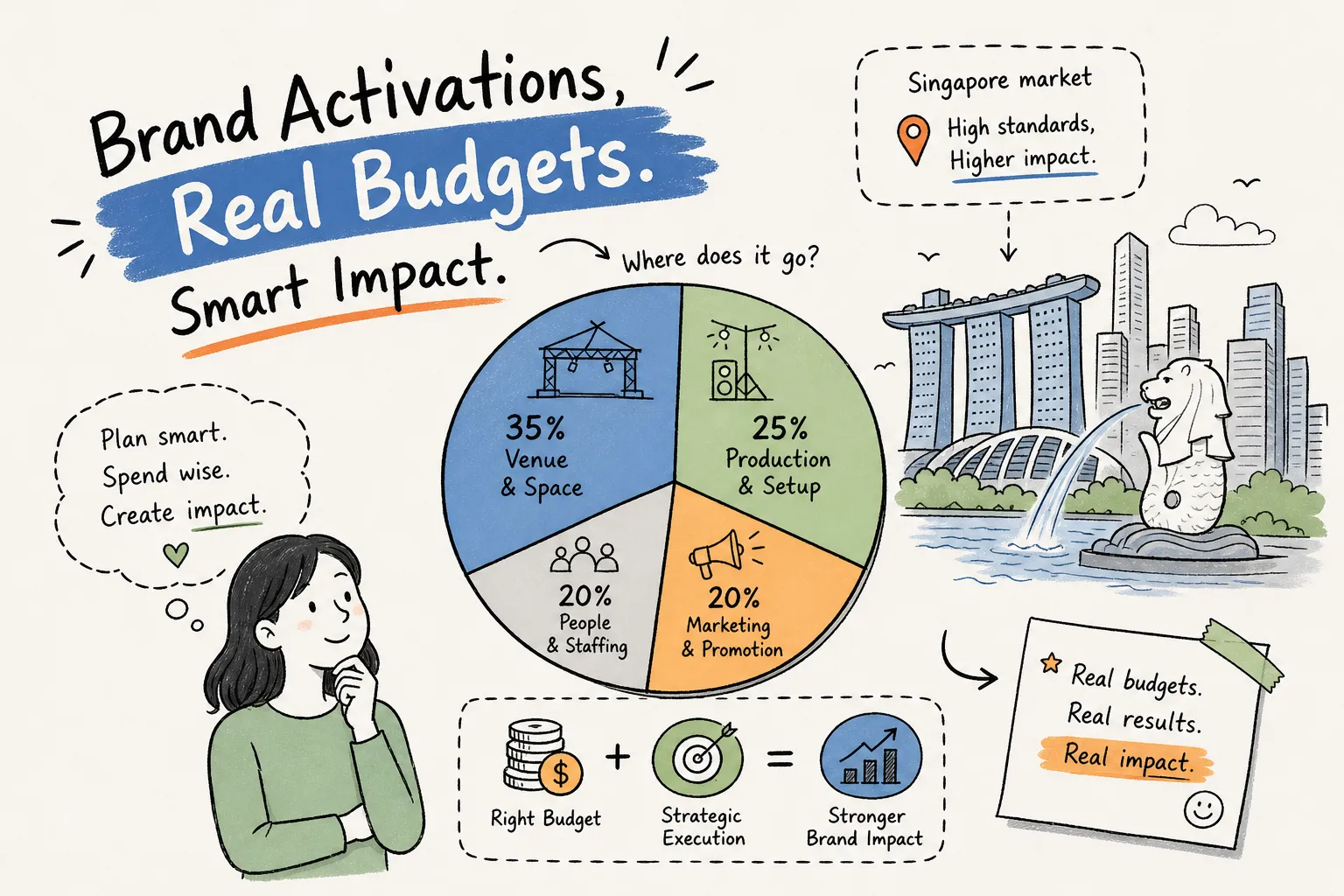
Venue rental in Singapore runs from S$2,000 for a small function room to S$100,000 or more for convention halls and premium event spaces. AV and production typically costs S$3,000 to S$50,000 depending on scale, and staging or booth builds range from S$2,000 for a simple setup to S$30,000 for a fully custom branded environment. A reliable rule of thumb: venue and F&B together absorb 25 to 35% of the total activation budget, while production and creative assets account for another 20 to 30%. These figures are drawn from 2026 Singapore market benchmarks and represent the two categories most clients underestimate in their first draft.
Staffing, talent and permits
Event crew rates in Singapore run from S$120 to S$250 per person per day for general staff, and S$300 to S$800 per day for technical specialists. Talent and entertainment commonly adds S$5,000 to S$15,000 depending on the format and scale.
Permits are a separate and frequently forgotten line-item. An SCDF Temporary Change of Use Permit costs around S$60 with at least three working days’ lead time. A URA Non-Renewable Temporary Occupation Licence requires at least a month’s lead time. An SFA Temporary Fair Permit, required for food sampling, costs S$60 and must be submitted at least two weeks before the event. Each of these has a different authority, a different timeline and a different consequence if missed. Budget for the application fees and, more critically, for the time required to prepare documentation.
Marketing, F&B and variable costs
Marketing and promotion typically accounts for 5 to 10% of the total activation budget: roughly S$1,000 on a S$20,000 activation, rising to S$12,500 on a S$250,000 campaign. F&B runs from S$15 to S$30 per person for light refreshments to S$100 or more per person for premium formats. These two categories are also where budgets get padded unnecessarily. A disciplined brief that fixes the format early saves real money here.
Hidden costs that quietly blow activation budgets
Most budget blowouts in Singapore do not happen because the headline numbers were wrong. They happen because of costs nobody planned for.
The overtime and extras trap
The most commonly missed items are venue overtime charges when setup or teardown runs long, AV extras such as last-minute microphones, streaming additions, power upgrades and Wi-Fi, and logistics costs for equipment transport, loading bay access and parking. These are real, they are frequent, and they are rarely quoted upfront unless you ask specifically.
GST, insurance and post-event charges
GST at 9% (per IRAS’s current rate) is a meaningful add-on to venue and F&B invoices, and it is not always visible in headline quotes. Public liability insurance is required by most malls and private venues in Singapore. Post-event cleanup, waste disposal, damage charges and content editing rounds are often invoiced separately after the event concludes. Build all of these into your brief before you agree to any number.
How much contingency to set aside
10 to 15% of the total activation budget is the standard contingency for a well-scoped Singapore activation. Raise that to 15 to 20% for outdoor events, highly custom builds, or campaigns that are still evolving at the time of briefing. Scope creep, vendor escalations and permit delays are common enough in Singapore’s activation market that a contingency is not optional. It is part of the budget.
Agency fees vs managing the activation in-house
The decision to hire an agency or run an activation internally is not purely a cost question. It is a capacity and risk question.
How Singapore activation agencies charge
There are three common fee structures: a percentage of total campaign budget (typically 15 to 25% in Singapore), a flat project fee for smaller or well-defined activations, and a monthly retainer for ongoing campaign support. On a S$50,000 activation budget, a 15 to 25% agency fee represents S$7,500 to S$12,500, separate from and additional to production costs. On a S$120,000 campaign, that becomes S$18,000 to S$30,000. The fee is real, but so is what it buys: vendor relationships, permit knowledge, production oversight and accountability when something goes wrong.
When DIY works and when it doesn’t
DIY makes sense when the activation is small and simple, internal teams have direct vendor relationships, and the format is repeatable. It breaks down when permits are complex, builds are custom, logistics span multiple locations, or the brand cannot afford a failed execution. Going in-house to save 20% on agency fees is, in our experience, a false economy, the resulting overtime, errors and management hours typically cost more than the saving. That said, every situation is different; the right call depends on your team’s capacity and the activation’s complexity.
How to set a reasonable brand activation budget in Singapore without cutting corners
A tighter budget does not have to mean a smaller idea. Two specific approaches consistently deliver more value per dollar in Singapore’s market.
Mobile pop-up formats as a cost-effective alternative
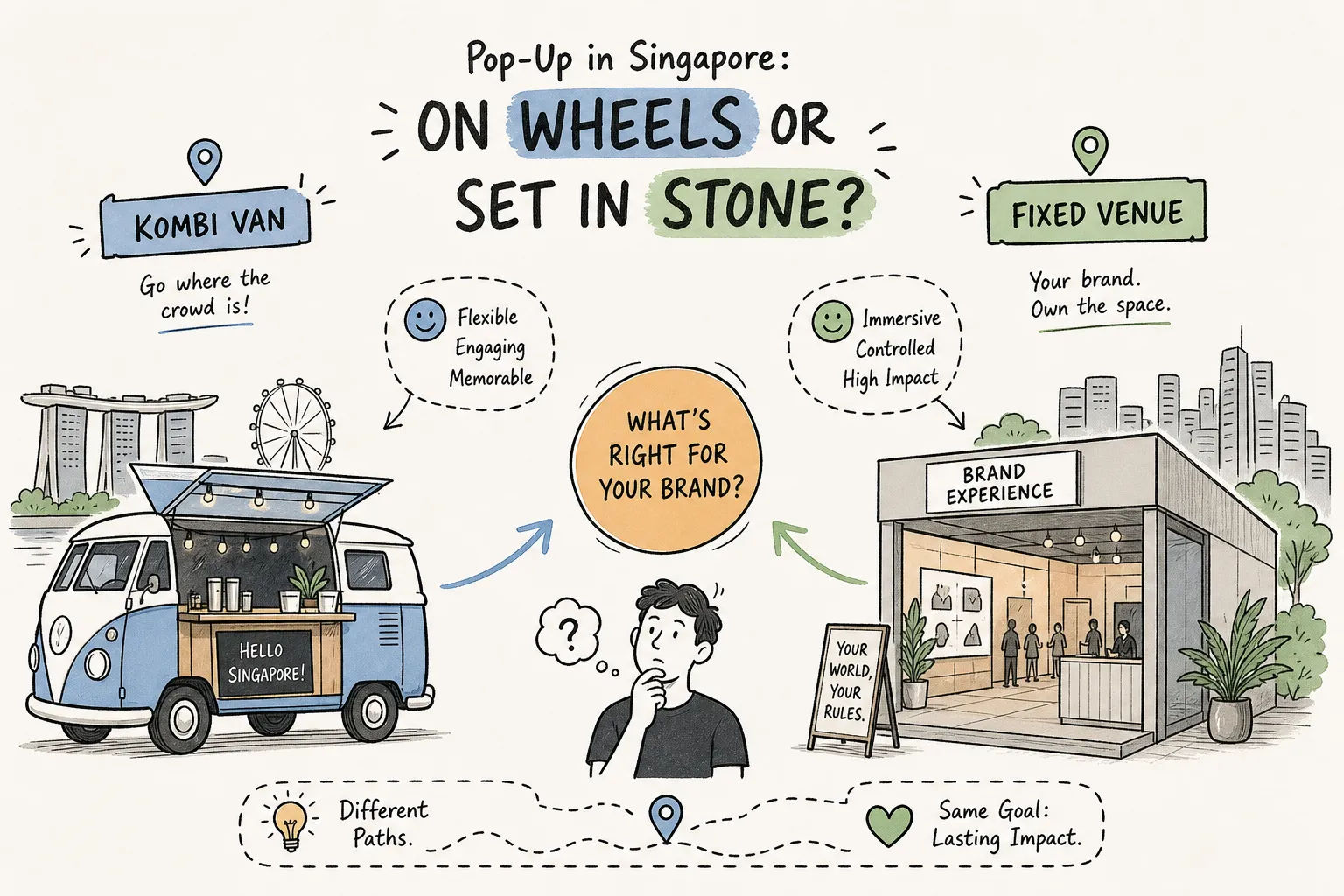
At Scoopy’s & Cream, one of the most consistent budget-savers we deploy is our fleet of fully branded Kombi vans @supericecreamtruck. A mobile pop-up can significantly reduce or eliminate conventional venue hire costs, deploying across indoor and outdoor locations across Singapore without a fixed footprint cost. Indicative Kombi hire rates in Singapore typically run from S$350 per hour, min. of a block of 4 hours ( half day ) , $2500 per day, depending on configuration and duration, compare that to venue rental of S$4,000 or more for even a modest function room, and the maths shifts considerably for shorter activations.
It is worth noting that mobile formats still require location-specific permissions, roadside deployments, mall placements and outdoor positions each carry their own approval processes, so factor those into the timeline. That said, for brands that need multi-location reach without a multi-location budget, the format offers real advantages: lower venue costs relative to fixed spaces, strong organic social visibility from the format’s visual distinctiveness, and faster deployment timelines compared to custom builds.
EIS structuring to recover qualifying spend
The Enterprise Innovation Scheme is a lever most brands overlook when building an activation budget. Where specific, demonstrably qualifying components of event expenditure are directly attributable to eligible activities, such as skills training, polytechnic collaborations or inbound trade missions, those costs may qualify for enhanced tax deductions under IRAS’s EIS framework. Brand activation as a whole is not a standalone qualifying category; only costs that meet strict IRAS definitions for the relevant pillars are eligible.
At Scoopy’s & Cream, EIS eligibility is part of how we build proposals, with full audit-ready documentation provided across the relevant pillars. We recommend consulting IRAS guidance and your tax adviser to identify which components of your activation may qualify. For a brand spending S$50,000 on a qualifying campaign, even partial EIS eligibility on specific line-items is not a footnote, it can materially reduce the net cost of the campaign.
A pre-commitment checklist before you lock in any activation budget
A budget is only as reliable as the questions you asked before agreeing to it.
What to confirm before signing
Resolve these before committing to any quote:
- Are permits included in the quote or billed separately?
- Does the quote include GST at 9%?
- What triggers overtime charges and at what rate?
- Is public liability insurance covered or an additional cost?
- What is the teardown and cleanup process and who pays for it?
- Is the contingency line agreed in writing?
Red flags in supplier quotes
Certain patterns reliably signal that a quote will grow after you sign. Watch for: unusually low venue fees with vague AV line-items; no mention of permits or insurance anywhere in the document; F&B quoted per person without service charge and GST stated separately; and activation builds quoted without a breakdown between materials and labour. Knowing these patterns before you sign is the difference between a budget that holds and one that doesn’t.
Build the budget before the brief, not after
So what is a reasonable budget for a brand activation in Singapore? There is no single number, it is a function of scale, format, location and how well the costs are structured from the start. The brands that avoid blowouts are the ones that build from real line-items rather than rough estimates, protect the budget with a 10 to 15% contingency from day one, and look for formats and structures that recover cost rather than simply reduce scope.
At Scoopy’s & Cream, we build cost-transparent proposals that include permit roadmaps, mobile format options to reduce venue spend, and EIS structuring where qualifying spend can be recovered. If you are putting together a brief and want a realistic brand activation budget framework for Singapore before you commit to any number, get in touch. The conversation starts with your brief, and we will tell you exactly what it should cost.